Car Repair Without Insurance: How to Pay and Get It Done Right
Car Repair Without Insurance: How to Pay and Get It Done Right

You can get a damaged car fixed without an insurance claim. You pay the shop directly, agree on the work in writing, and keep the paperwork. It works best when the damage is clear, nobody is hurt and no one else’s property is involved. At Leslie’s Auto Body in Fords, NJ, we give free estimates with no obligation and without starting a claim, so you can see the real number before deciding anything.
TL;DR
- “Without insurance” means two things: you have no policy, or you have one and choose to pay the shop yourself instead of filing a claim.
- Paying yourself tends to make sense when the repair costs about the same as your deductible or less, and nobody else is involved.
- Get a written estimate, ask to be contacted before the price goes up, and pay in a way you can trace.
- Low-speed hits can hide damage. Have the car inspected before you decide the damage is too small to matter.
- If another driver caused the damage, their insurer or your own coverage may still pay. Check before you spend your own money.
Table of Contents
- What “repair without insurance” actually means
- When paying out of pocket makes sense
- How to get the repair done, step by step
- When the other driver caused the damage
- Beware shops that offer to waive your deductible
- What we do for drivers paying on their own
- Our point of view
- FAQ
- Sources
What “repair without insurance” actually means
The phrase covers two different situations, and the right steps depend on which one is yours.
In the first, you have no active policy. Nobody is going to reimburse the shop, so the bill is yours unless another driver is responsible. In the second, you have a policy but decide not to use it. Insurance.com describes repairing a car without insurance as paying for the work directly at the shop of your choice instead of running the loss through a claim. It can also mean settling privately with the other driver when both sides agree.

The same source notes that you may not need a claim at all after a minor accident, for example when the damage is below your deductible and a claim would not produce a payout.
Either way, the repair itself is the same job. The difference is who approves the estimate. With a claim, an adjuster has a say. Without one, you and the shop agree on the scope and the price, so the written agreement carries more weight.
When paying out of pocket makes sense
There is no single rule, but a few situations come up again and again.
The repair costs less than your deductible, or only a little more. ValuePenguin notes that collision and comprehensive deductibles can range from $50 to $2,000, and it suggests paying yourself when the repair costs less than the deductible or just above it. A $700 bumper repair under a $1,000 deductible would never have paid out anyway.
The damage is clear and nobody else is involved. Freeway Insurance says private payment fits when the damage is minor, the costs are clear and no one else is involved. A scrape against a pole or a parking-lot ding fits this description.
The other driver agrees and nobody is hurt. Insurance.com lists cases such as the other driver agreeing not to involve insurance with no injuries, or cosmetic damage not worth repairing. It also lists situations where claims history could raise your rates sharply or put your renewal at risk.
When to slow down
Paying privately gets riskier in three situations, according to Freeway: someone may be injured, another vehicle or property was damaged, or hidden damage may exist. Paying the shop does not stop an injury claim later. ValuePenguin adds that if you pay yourself and the repair then costs more than expected, you may not be able to file a claim afterward.
If anyone complains of pain after a crash, even a day later, see a doctor first. Then talk to your insurer or the other driver’s insurer before you settle anything privately.
How to get the repair done, step by step
1. Document everything before the car moves
Photograph the damage from several angles, the other vehicle, the plates, and the scene. Get the other driver’s name, phone number, license number and insurance details if there was one. The Texas Department of Insurance recommends photographing the other driver’s insurance card and license, the cars and damage, and collecting witness information. Do this even if you plan to pay yourself. If the situation changes next week, these photos are your evidence.
If the damage is serious, protect the car from further harm and keep it available for inspection. Maine’s insurance guide warns that an insurer might refuse later damage or deny a claim if you did not protect the vehicle and allow inspection first.
2. Get the estimate before you decide anything
The order matters here. Get the price first, then choose between claim and cash. Many drivers do it the other way and file a claim just to find out what the repair costs.
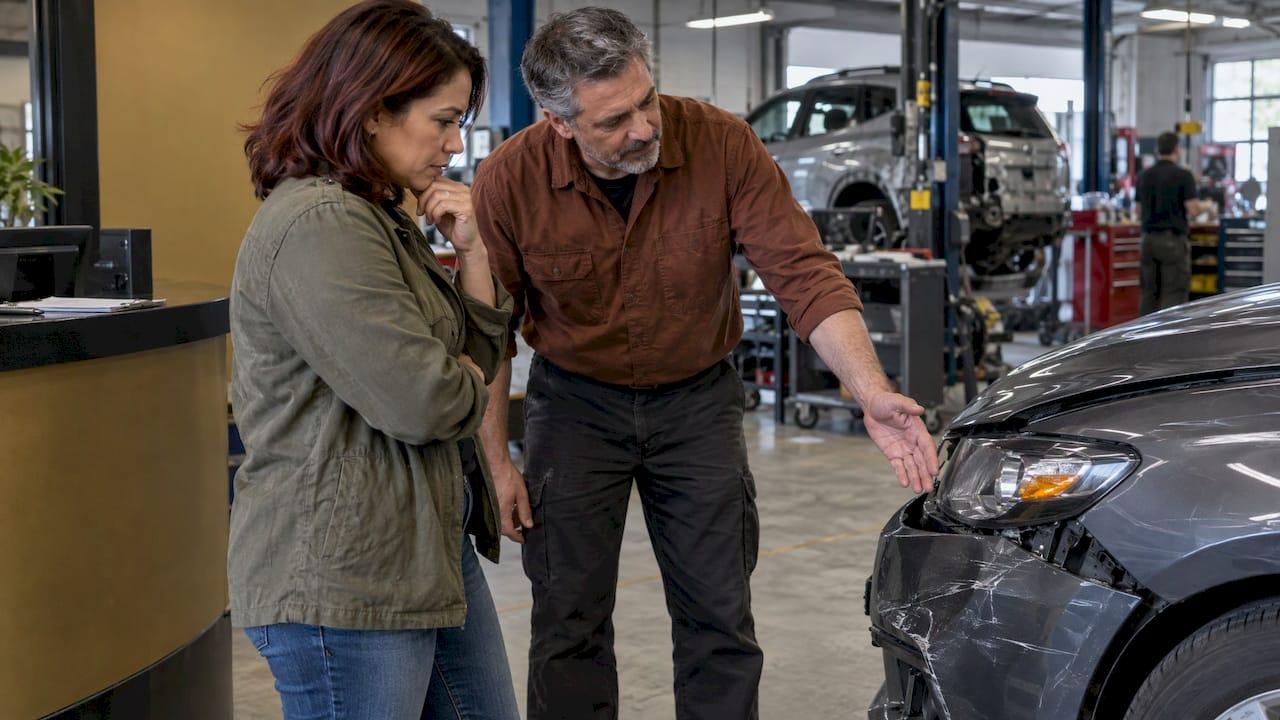
At our shop on King Georges Post Rd in Fords, estimates are free and carry no obligation. Getting one does not start a claim. You can walk in with a damaged bumper, see the number, and then decide whether it sits above or below your deductible. If you want to compare it with other written estimates, that is your right.
3. Insist on a written estimate that says what will be done
AAA advises insisting on a written estimate that describes the work and the cost. It also says a repair order can require the shop to contact you before costs pass a set amount, and that this limit should be stated clearly.
Rules differ by state. Ohio’s attorney general says an estimate must include a description of the work, the expected completion date and the expected cost when you request one. Whatever your state requires, ask for these items:
- Each repair line, with labor and parts separated
- Whether parts are new, used or aftermarket
- Paint and refinishing, listed as its own line
- The expected completion date
- The amount at which the shop must call you before going further
4. Have a qualified shop look beneath the surface
A small impact is rarely small underneath. Freeway says low-speed hits can damage alignment components, suspension parts, mounting points, cooling systems and driver-assistance technology, and it recommends asking a qualified repair shop to inspect before assuming a claim is too minor.
This is the main reason to get the estimate done in person rather than from phone photos. A cracked bumper cover can sit on top of bent reinforcement behind it. If the damage turns out to reach the structure, our frame and structural repair work is where the repair continues. For cosmetic panel damage, our dent and bumper repair is the usual route.

5. Agree on how surprises will be handled
Once a panel comes off, a shop may find more. That is normal, and the way to handle it is to agree on the process before work begins.
Some states put numbers on it. Minnesota’s Truth in Repairs Act lets a shop exceed the written estimate only after informing the consumer and providing a revised estimate, and then it may not charge more than 10 percent above that revised figure. Ohio’s guidance says that if a repair will cost more than 10 percent over the original estimate, the business must get your authorization. These are examples from other states, not New Jersey rules. The principle is what carries over: no extra work without your yes, and a new number in writing.
6. Pay in a way you can trace
Insurance.com advises paying directly for the repairs, getting any agreement with the other driver in writing, using traceable payment methods and keeping the records. If the other driver is supposed to reimburse you, make sure they can pay before the repairs are completed, not after.
Keep the estimate, any revised estimate, the final invoice and your payment record together. Minnesota’s act requires an invoice when repairs cost more than $50 or when work is done under a warranty, service contract or insurance policy. Even where the law does not require it, ask for one.
7. Ask for the final invoice and your old parts
At pickup, compare the invoice with the estimate line by line. Ohio’s guidance says the business must return replaced parts unless you agreed to their reuse, rebuilding or return to the manufacturer under warranty. Asking for them is reasonable anywhere.
Our aim on every job is a repair that is detailed, matched to factory standards and finished before the car goes home. Walk around the car in daylight, check panel gaps and paint match, and ask questions before you sign.
When the other driver caused the damage
Paying yourself is not the only no-claim route, and it is not always the cheapest. If someone else hit you, the money may not need to come from you.
The Texas Department of Insurance explains that if you think the other driver caused the accident, you can report it to their insurer, which should pay for your repair, medical bills and a rental car. If the other driver is uninsured or drove away, your collision coverage may pay for repairs, and uninsured or underinsured motorist coverage may pay for repairs, a rental car and pain and suffering. Illinois’ insurance department adds that you can file a first-party claim with your own insurer, if you carry the right coverages, or a third-party claim with the other driver’s insurer.
These are descriptions from other states, so check your own policy and your state’s rules. If you have no policy and the other driver is uninsured, you will likely carry the bill yourself, and a clear written estimate becomes the document you use if you pursue them for reimbursement.
Two more points apply wherever you live:
- Reporting rules. Many states require a crash report to the motor vehicle agency above a damage threshold or if anyone is hurt. California, for example, requires a DMV report within 10 days when anyone is injured or damage exceeds $750. Paying privately does not remove a reporting duty. Check the rule for your state.
- Storage fees. Maine’s guide warns that storage charges can climb quickly during a dispute, and an insurer may stop paying them. Do not leave a car sitting in limbo.
Beware shops that offer to waive your deductible
When money is tight, a shop that offers to absorb your deductible or throw in extra work sounds generous. Michigan’s consumer guide to collision repairs warns against facilities that offer to waive your deductible or do more work at no extra charge, because needed repairs can get short-cut, which can affect safety. Pay a fair price for a complete repair instead.
What we do for drivers paying on their own
Leslie’s Auto Body is an independent collision repair shop at 908 King Georges Post Rd in Fords, NJ, serving drivers in Fords, Woodbridge Township, Edison, Perth Amboy, Metuchen and South Amboy. The shop has operated under the same name for more than 40 years. We repair collision damage, dents and bumpers, frames and structure, and we paint and refinish.
Free estimates come without obligation. You can start with our collision repair page, or come in with the car and we will look at it in person. If you decide to file a claim after seeing the number, our insurance claim assistance is there for claims with major carriers.

We are not a direct repair shop for any insurer, and we are not partnered with or approved by one. The repair plan is built around your car and your decision.
Our point of view
Most people who come to us after a crash ask the same thing first: do I have to go through insurance? Our answer is that the choice is yours, and you should make it with a real number in your hand.
That is why we do not run a direct repair program for any insurer. We decided not to work at the mercy of the insurance company, because a shop that answers to an insurer’s schedule is not free to answer to the car owner. When you pay yourself, that independence matters even more: the scope, the price and the finish are agreed between you and us, in writing.
Our advice is simple. Get the estimate first. Let us look for damage under the surface, not just what shows. Compare the total with your deductible, and then decide. Whether you pay yourself or file a claim, you should leave with an itemized invoice and a car that has been repaired to factory standards.
Robert De La Cruz
FAQ
Can I get my car repaired if I have no insurance?
Yes. A shop will repair your car when you pay for the work. Without a claim, you and the shop agree on the scope and the price directly, so get the estimate in writing and keep the invoice. If someone else caused the damage, their insurer may be responsible for the cost.
Is it better to pay for repair myself or go through insurance?
It depends on the numbers and on who is involved. Sources such as ValuePenguin suggest paying yourself when the repair costs less than your deductible or only slightly more. Where someone is injured, other property is damaged or hidden damage is possible, a claim is usually the safer route. An estimate from us shows you the figure before you choose.
Will a free estimate start an insurance claim?
Not at our shop. Our estimates are free, carry no obligation and do not start a claim. You can look at the number first and decide afterward.
What should a written repair estimate include?
A description of the work, itemized labor and parts, the expected completion date and the expected cost. AAA also recommends a stated limit at which the shop must contact you before the cost goes higher. Keep it with your final invoice.
Sources
- How to settle a car accident without insurance, Insurance.com
- Should You File a Small Auto Insurance Claim or Pay Out of Pocket, Freeway Insurance
- When to Pay Out of Pocket After a Car Accident, ValuePenguin
- Maine Bureau of Insurance: Making the Claims Process Easier
- Texas Department of Insurance: Were you in a wreck?
- AAA Guide to Auto Repair
- Ohio Attorney General: Know Your Consumer Rights, Repairs and Services
- Minnesota Attorney General: Truth in Repairs Act
- Illinois Department of Insurance: Filing a Claim with Your Own Insurance Company
- California Department of Insurance: So You’ve Been in an Accident, What Next?
- Michigan Secretary of State: Consumer’s Guide to Collision Repairs