Car Paint Matching: How a Body Shop Gets the Color Right
Car Paint Matching: How a Body Shop Gets the Color Right

A good paint match comes from a process, not from a code. The shop starts with your car’s factory paint code, checks it against the actual weathered paint on your car, tests the mix on a sample card, and then blends the new color into the surrounding paint so the eye finds no edge. If you want that done for a scratch, a bumper or a repaired panel in Fords, NJ, our auto painting and refinishing service is built around that process, and estimates are free with no obligation.
TL;DR
- Your paint code is the right starting point, but it does not guarantee a match: age, sun, earlier repairs and the finish type all change how the color looks today.
- Professionals scan the real paint, pick the closest formula variant, and spray a test card before touching your car.
- Metallic and pearl colors are the hardest, because they change with the angle you view them from and with how the paint is sprayed.
- The industry standard is a blendable match: the new color is faded into neighboring paint so slight differences disappear.
- Touch-up pens suit tiny chips. Scratches, faded panels and anything larger are shop work.
Table of Contents
- Where to find your factory paint code
- Why the code alone does not give a perfect match
- How a shop matches your color step by step
- Why blending is how invisible repairs are made
- Metallic, pearl and tricoat colors
- Touch-up paint or a body shop?
- What to ask before you hand over the keys
- Paint matching and your insurance claim
- Get your paint matched in Fords
- Our view on color matching
- FAQ
- Sources
Where to find your factory paint code
Every car leaves the factory with a code for its exterior color. The most common spot is a label on the driver-side door jamb. Look for a field marked PNT, PAINT, COLOR, EXT or C/TR. On a Toyota, for example, a line reading C/TR 1G3 FA09 means 1G3 is the exterior color and FA09 is the interior trim, according to a Tacoma paint code guide. Ford and Lincoln owners will find a short code after “EXT PNT” on the door jamb label, and Lincoln’s own support page explains how to look it up.
If the door jamb label is missing or worn, other places to check are the glove box, the area near the fuse box, under the hood on the radiator support, and the trunk. A VIN guide points out that the VIN does not show the paint code itself but identifies the exact vehicle, so a dealer can look the code up from it.
Write the code down exactly, letters and numbers. A color name such as “Midnight Black” is not enough, because names are vague and repeat across years and models.
Why the code alone does not give a perfect match
The code tells you what color the factory aimed for. It does not tell you what your car looks like after years on the road. Fender Bender reports that color can differ between assembly plants without the code changing, and that a car painted in January may differ from one painted in March. Weather, dirt and exhaust fumes shift the finish further over time.
i-CAR, the collision industry’s training body, lists the reasons the standard formula is not always the answer:
- manufacturing variances when the car was painted at the factory
- different production plants and paint suppliers
- color variants that paint makers have not yet identified
- weathering of the finish
- panels that were repaired or repainted before
An AkzoNobel technical bulletin adds that weathering hits panels differently depending on which way the car is usually parked and how each panel faces the sun. Your roof and hood often age faster than your doors.
That is why two cars with the same code can look slightly different, and why the same car can look different from panel to panel.
How a shop matches your color step by step
Here is the routine paint manufacturers describe. Each step is a place where a rushed job goes wrong.
1. Confirm the code and check the panel’s history
PPG’s standard operating procedure for identifying a color formula tells technicians to get the factory color code and to check whether the area was refinished before. A panel that was repainted years ago may not match the rest of the car even if the original paint did.
2. Clean and polish the area
Dirt and oxidation fool the eye. Fender Bender notes that compounding and polishing should come before a color comparison, so you are judging the paint and not the grime.
3. Scan the paint and look up the formula
A handheld spectrophotometer reads the paint from several angles, often five to seven, and software compares the reading with a database of paint formulas. It returns the closest match along with a tolerance rating showing how visible the difference would be, as explained here. A scan is most reliable on a clean, flat, undamaged area of the car.

4. Compare variant chips against the car
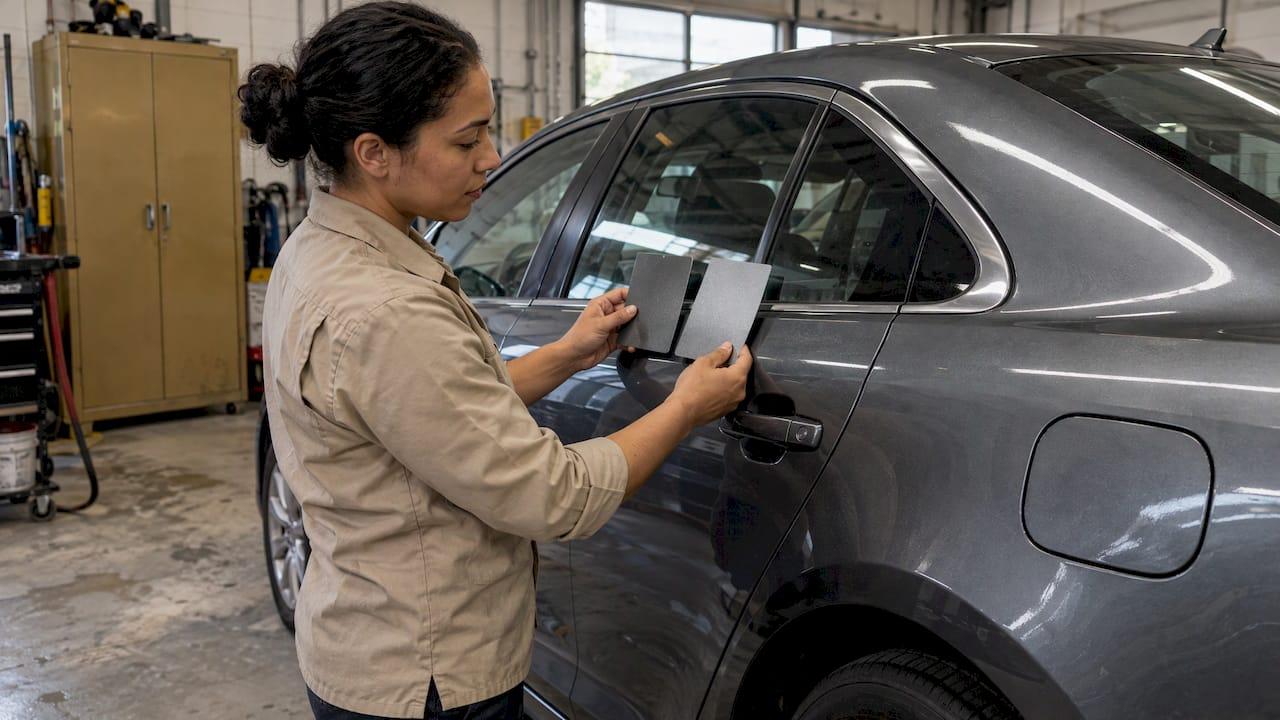
One code can have many formula variants. The painter holds sample chips of each variant against the car under color-corrected light or natural sunlight. Fender Bender’s guide to advanced color matching says to compare straight on and at 45 degrees to the left and right. It also says to look for a minute or less, then look away for a few seconds, because eyes tire and start to misjudge color.
5. Spray a test card
When the match is in doubt, the painter mixes a small batch and sprays a test card the way the car will be painted, including clearcoat. PPG’s procedure calls for mixing only a small amount first, about 1.8 ounces, before committing to the full job. The color is judged on the card, next to the car, before any paint goes on your panel.
6. Spray, clear and blend
The real panel is painted next, and the color is faded into the neighboring paint. The next section covers that.
We do this work in our own shop at 908 King Georges Post Rd in Fords. Our approach is that each job is detailed, matched to factory standards and finished before the car goes home. You can see finished jobs on our Our Work page.
Why blending is how invisible repairs are made
Even a very close formula will not be identical to ten-year-old paint. So the standard is not an exact match but a blendable one. Fender Bender’s guide to blending describes it as the repair method all paint manufacturers recommend: the repaired panel gets a very close match, then the color is faded toward the edges of that panel or onto the adjacent panel, so slight variations are usually not noticeable.
Mitchell’s refinish procedures draw a useful line between two terms. A spot repair covers the damaged area and blends into the original finish of the same panel. Blending means applying color to part of an adjacent undamaged panel. In both cases clearcoat goes on the whole panel, and the major paint manufacturers recommend carrying it to the nearest panel edge.
What this means for you: if a shop tells you it needs to paint part of the fender next to a repaired door, that is normal practice. It is how the repair avoids a visible line. It is not an upsell.
Tinting the formula can help, but the AkzoNobel bulletin says tinting alone typically does not remove the need for blending to get a repair no one can see.

Metallic, pearl and tricoat colors
Solid colors are forgiving. Metallics and pearls are not, and that is why a color code often fails on them.
Metallic paint contains tiny aluminum flakes. How they settle depends on how wet or dry the paint is sprayed. Axalta’s color theory brochure explains that a wetter application sinks the flakes deeper and reflects less light, giving a darker color. It also notes that the true color of a basecoat and clearcoat paint cannot be judged until the clearcoat is on.
Pearl and mica finishes use transparent flakes that shift color with the viewing angle. Fender Bender’s reporting says that three-stage white pearls and tan metallics are among the hardest to match. The AkzoNobel bulletin adds that carmakers’ growing use of special-effect pigments makes these finishes more vulnerable to weathering, and that an undetectable transition may take a mix of tinting, blending and adjusted spray technique.
Practical rules for these colors:
- Judge the match only after clearcoat, never on bare basecoat.
- View the car in daylight, from several angles, not just head-on.
- Expect the shop to blend into neighboring panels rather than painting one panel in isolation.
- Avoid a scan taken from a scratched, dirty or already repainted spot.
If your car has been kept in a garage or storage, its paint may have aged differently from a car parked outside; a classic car storage guide is useful for anyone weighing how and where a prized car is kept.
Touch-up paint or a body shop?
Touch-up paint in a pen or bottle, bought by paint code, suits a chip the size of a pencil eraser. It will not fix any of the following:
- a long scratch that goes through the clearcoat
- a panel that has faded or turned chalky
- a bumper scuff across a wide area
- peeling or cloudy clearcoat
- a repair next to a panel with different weathering
On those, the problem is no longer the code. It is the difference between fresh paint and aged paint, and closing that gap takes scanning, test cards and blending. If your clearcoat is cloudy or peeling, our guide on clear coat repair covers the causes and when a respray is needed. For dents and scuffs on bumpers, see our dent and bumper repair page.
Matching also matters on larger repairs. After a collision, the paint step comes last, so the color match is what the owner sees every day. Our collision repair service includes refinishing as part of the job.
What to ask before you hand over the keys
You do not need to know paint chemistry to judge a shop. These questions are fair and a good shop answers them easily:
- Will you blend into the adjacent panel, and why or why not?
- Will the clearcoat cover the full panel?
- Is the color checked on a test card before it goes on the car?
- Will I see the car in daylight before I pay?
When you pick up the car, look at it outside, not under shop lights. Walk around it, and look at the repaired area from a low angle and from the side. Then compare it to the panels next to it.
Paint matching and your insurance claim
If a collision claim includes paint, you have the right to choose where the repair is done. We are an independent shop and not a direct repair shop for any insurer, so repair decisions are made for you. We assist with claims from major carriers through our insurance claim assistance service. Estimates are free and do not start a claim or obligate you.
Get your paint matched in Fords
We do automotive painting and color matching, from a single scratch to a full collision repair, at our shop in Fords, NJ. Bring the car in and we will look at the paint in person. Estimates are free and without obligation, and each job is detailed, matched to factory standards and finished before the car goes home.

Start with our auto painting and refinishing page, or call the shop if you are in Fords, Edison, Woodbridge, Metuchen or Perth Amboy. Metuchen drivers can also see our Metuchen location page.
Our view on color matching
Most people think paint matching is a matter of finding the right code. It is not. The code is where we start. What decides the result is whether the painter looks at your car, in good light, and then tests the color before it goes on.
We run an independent shop, and we chose that on purpose. A match takes time: the test card, the second look, the blend into the next panel. We want that decision to be about your car and not about anyone else’s schedule or budget.
When a customer brings in a faded fender or a scratch along a door, we tell them plainly what the repair involves and what the finished panel should look like. Our goal is a repair you cannot find from three steps away, and a car you can drive home finished.
Robert De La Cruz
FAQ
Can a body shop match my car’s paint exactly?
Shops aim for a match you cannot see, not a mathematically identical one. Paint ages, so a fresh formula will differ slightly from your weathered paint. The industry answer is to pick the closest variant, confirm it on a test card, and blend the color into adjacent paint so the transition disappears.
Is the paint code enough to buy matching paint?
It is the right start, but not a guarantee. One code can have many variants from different plants and batches, and age, sun exposure and earlier repairs change how the paint looks. i-CAR lists these as the reasons the standard formula is not always the answer.
Why does my new paint look different in sunlight?
Light changes how color looks, and metallic and pearl paints change with angle. Fender Bender advises checking color under color-corrected light or sunlight and from straight-on and 45-degree angles. Always check a repair outdoors before you accept it.
Do I need to repaint the whole car to fix one panel?
No. The repaired panel is painted and the color is faded into neighboring paint. Clearcoat goes over the whole panel, and the major paint makers recommend carrying it to the nearest panel edge. The shop looks at your car’s condition to decide how far to blend.
Sources
- Advanced color matching, Fender Bender
- The Quest for a Quality Match, Fender Bender
- Blending, Fender Bender
- Identify Color Formula, PPG refinish SOP
- Axalta color theory brochure
- Color Match: Blending and Tinting, i-CAR
- AkzoNobel TSB AN24.01, Tinting and Blending
- What is the paint code for my Lincoln?
- Find OEM Paint Code, VinAudit
- The Art and Science of Matching a Factory Paint Color
- Toyota Tacoma Paint Code Location Guide
- Classic Car Storage: How to Choose, Prepare and Budget